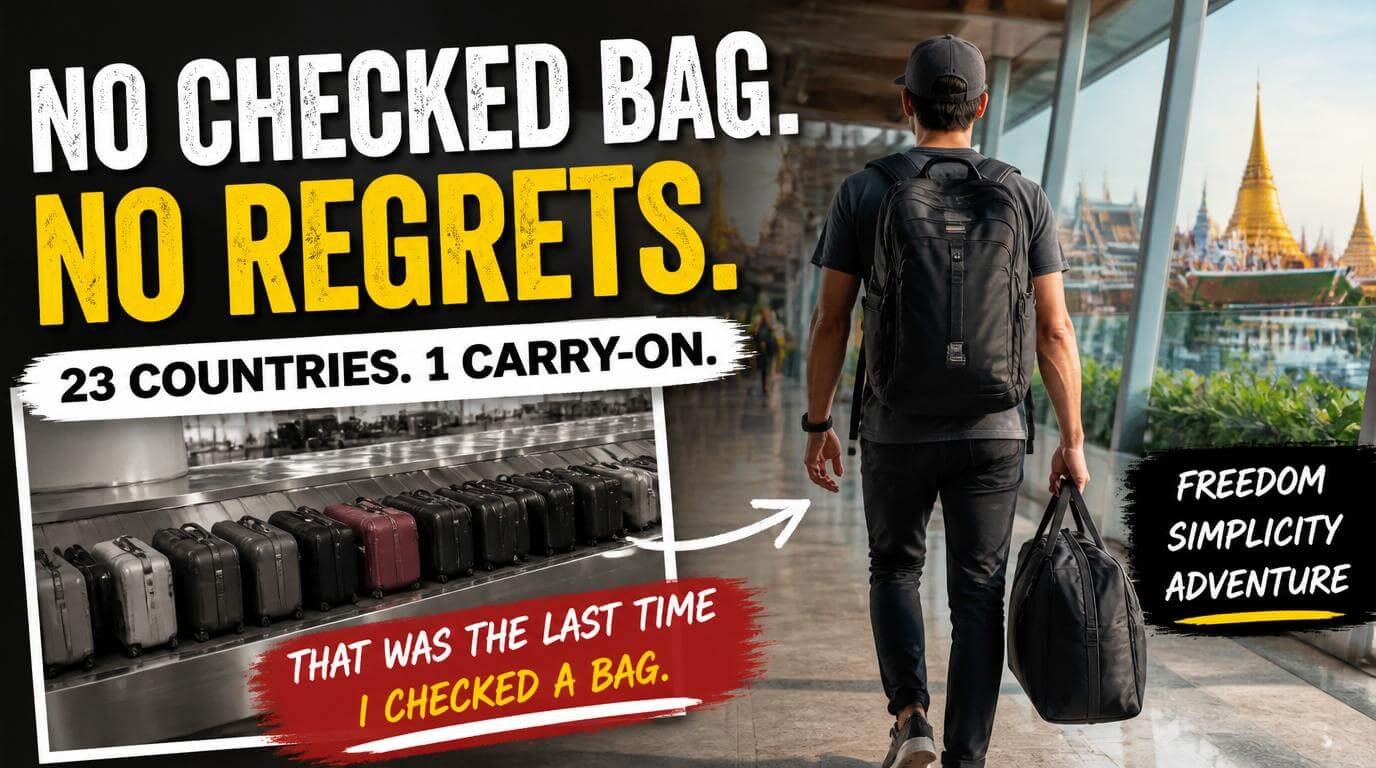
Traveling internationally without checked luggage for minimalist long term travelers sounds extreme until you actually try it. I stood at a baggage carousel in Bangkok three years ago, watching suitcase after suitcase roll past that wasn’t mine. Two hours later, the airline confirmed my bag was in Frankfurt. That was the last time I ever checked a bag. Since then, I’ve crossed 23 countries with nothing but a carry-on and a personal item. It changed everything about how I move through the world.
Why Traveling Internationally Without Checked Luggage Makes Sense for Long Term Travelers
Short-trip tourists can afford to overpack. They’re going to one destination and coming home. But when you’re bouncing between countries for months or years, every extra kilogram becomes a tax you pay daily. You pay it on buses with no luggage compartments. You pay it climbing six flights to a hostel room in Lisbon. You pay it emotionally when you’re stressed about theft or loss.
Going carry-on only eliminates an entire category of travel anxiety. You walk off the plane and straight to the exit. No waiting, no lost bag claims, no rebooking disasters. On budget airlines like Ryanair, AirAsia, and Wizz Air, skipping checked luggage saves $25 to $60 per flight. When you’re taking 30 or 40 flights a year, that adds up to over a thousand dollars. That’s a month of living expenses in Southeast Asia.
The mental shift matters just as much. Owning less stuff while traveling forces you to be intentional. You stop buying things you don’t need. You get faster at packing and unpacking. You become the person breezing through airports while everyone else wrestles with oversized roller bags.
Choosing the Right Bag (This Decision Matters More Than Anything Else)
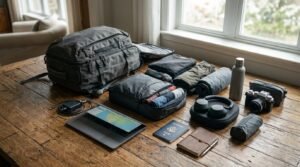
Your bag is your closet, your dresser, and your storage unit rolled into one. Get this wrong and the whole system falls apart. I’ve tried five different bags over two years, and the one I keep coming back to is the Osprey Farpoint 40L. It fits most international carry-on size limits (55 x 35 x 23 cm), opens like a suitcase, and has a laptop compartment.
Other solid options include the Tortuga Outbreaker 35L for people who want more organization, and the Cotopaxi Allpa 35L for a slightly smaller footprint. The Patagonia Black Hole MLC works well too, especially if you prefer a duffle-style opening.
Here’s what most people get wrong: they choose based on how the bag looks empty. You need to pack it fully, wear it for an hour, and walk up stairs. That’s the real test. If it digs into your shoulders or swings away from your back, move on.
What About a Personal Item?
Most airlines let you bring a personal item in addition to your carry-on. I use a packable daypack, specifically the Matador On-Grid 16L. It folds down to nothing inside my main bag and then becomes my daily backpack once I arrive somewhere. I carry my laptop, chargers, passport, and in-flight essentials in it during travel days.
The Capsule Wardrobe That Actually Works Across Climates
Packing light doesn’t mean wearing the same dirty shirt for a week. It means choosing versatile pieces that mix and match, dry fast, and don’t wrinkle.
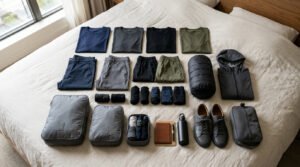
Here’s my exact clothing list for a typical multi-month, multi-climate trip:
- 3 merino wool t-shirts (I use Unbound Merino and Wool & Prince)
- 1 long-sleeve button-down that works for both casual dinners and temples
- 2 pairs of shorts (one with a swim liner so it doubles as swimwear)
- 1 pair of lightweight travel pants (Western Rise Evolution)
- 5 pairs of merino underwear
- 3 pairs of merino socks
- 1 lightweight down jacket (Uniqlo Ultra Light Down packs tiny)
- 1 rain shell that compresses small
Merino wool is the secret weapon here. It resists odor for days, regulates temperature, and dries faster than cotton. Yes, it costs more upfront. But when you only own three shirts, spending $60 each feels reasonable.
For cold destinations, I layer instead of carrying bulky items. The down jacket plus the rain shell plus the long-sleeve shirt handles temperatures down to about 40°F comfortably. If I’m headed somewhere genuinely cold, like Patagonia or Iceland, I’ll buy a cheap fleece locally and donate it before I leave.
Toiletries and Gear: The Stuff That Secretly Takes Up All the Space
Most people nail the clothing and then blow their space budget on toiletries and random gear. Here’s how I keep this category tiny.
I use a single clear quart-size bag for liquids and keep it minimal: a 3 oz sunscreen, a small tube of toothpaste, a tiny deodorant, and a travel-size Dr. Bronner’s soap that works as body wash, shampoo, and even laundry detergent. That’s it. I buy anything else I need locally, and you can find basic toiletries in virtually every country on Earth.
For tech, I carry a laptop (MacBook Air), my phone, a small power bank, a universal adapter (the Epicka is great), one USB-C cable, one Lightning cable, and earbuds. No camera anymore. Phone cameras are genuinely good enough now, and ditching a dedicated camera freed up significant weight and space.
Other gear worth its weight: a microfiber towel (because not every Airbnb provides towels), a small first aid kit, a headlamp, and a reusable water bottle with a filter like the Grayl UltraPress. Everything else, I leave behind.

Doing Laundry on the Road Without Losing Your Mind
The question everyone asks when they hear about carry-on only travel is, “But how do you do laundry?” Honestly, it’s the easiest part.
In most of Asia, laundry services cost $1 to $3 per kilogram. You drop off a bag in the morning and pick it up clean, dried, and folded by evening. In Latin America, it’s similarly cheap. In Europe, laundromats exist in every mid-size city, and many hostels have washing machines.
When none of those options exist, I hand wash in a sink using Dr. Bronner’s or a small packet of travel laundry sheets. Merino wool shirts need about 30 seconds of washing and dry overnight on a hanger. I usually do a sink wash every three to four days and a proper laundry drop-off once a week.
The trick is to never let laundry pile up. If you wash two items every other night, it never becomes a chore. It just becomes a small habit, like brushing your teeth.

Navigating Airline Rules Without Getting Your Bag Gate-Checked
Airline carry-on policies are inconsistent, confusing, and sometimes enforced by gate agents having a bad day. This is the biggest practical challenge of traveling internationally without checked luggage for minimalist long term travelers, and you need a strategy for it.
First, know the specific limits for every airline you fly. Most international carriers allow a bag up to 7 to 10 kg, but some budget airlines (looking at you, AirAsia) enforce weight limits strictly. Ryanair technically allows only 10 kg for a carry-on if you’ve paid for priority boarding.
Second, wear your heaviest items during flights. My travel pants, down jacket, and shoes go on my body, not in my bag. This can shave 2 to 3 kg off your bag weight.
Third, keep your bag looking small. A soft-sided backpack that you can compress with straps looks much smaller than a rigid suitcase at the same volume. Gate agents usually eyeball bags rather than measure them. If your bag doesn’t look oversized, you almost never get questioned.
Fourth, if you’re flying a notoriously strict airline, put your laptop and heavy items in your personal item. Most airlines don’t weigh the personal item separately.
I’ve taken well over 100 flights like this and been asked to weigh my bag exactly four times. I passed three of those by shifting stuff to my jacket pockets.
What You Actually Miss (And What You Don’t)
I won’t pretend there are zero trade-offs. Sometimes I wish I had a nicer outfit for an unexpected dinner invitation. Occasionally I want a specific tool or gadget I left behind. There was one week in Japan where I really wished I’d packed a second pair of pants because the only pair I had got soaked in a rainstorm and took forever to dry.
But here’s what surprised me: the list of things I thought I’d miss is much longer than the list of things I actually miss. I thought I’d miss having multiple shoe options. I don’t. I thought I’d miss having a variety of jackets. Nope. I thought I’d feel deprived or somehow less prepared. Instead, I feel the opposite. I feel free, fast, and weirdly more confident.
The trade-offs are minor and manageable. The benefits, speed, savings, flexibility, less stress, are daily and significant.
My Exact Packing List (Everything I Carry)
For anyone who wants the full picture, here’s literally everything in my bag:
- Osprey Farpoint 40L (main bag)
- Matador On-Grid 16L (packable daypack / personal item)
- 3 merino t-shirts
- 1 button-down shirt
- 2 pairs of shorts (one swim-capable)
- 1 pair of travel pants
- 5 merino underwear
- 3 merino socks
- 1 packable down jacket
- 1 rain shell
- 1 pair of trail runners (worn, not packed)
- 1 pair of flip-flops
- MacBook Air, phone, power bank, cables, adapter, earbuds
- Toiletry bag with liquids
- Microfiber towel
- Grayl UltraPress water bottle
- Headlamp
- Small first aid kit
- Passport, copies of documents, one credit card, one debit card
Total weight when fully packed: around 8.5 kg, including the laptop. Without the laptop, it’s closer to 7 kg.
FAQs
Can you really travel long term with just a carry-on?
Absolutely. I’ve done it for over two years across 23 countries, including cold climates. The key is choosing the right fabrics, doing laundry regularly, and being honest about what you actually use versus what you pack “just in case.” Most long-term travelers realize they use about 20% of what they bring. Cut the other 80%.
What happens if an airline forces you to check your carry-on?
It’s rare but it happens, usually on small regional planes with limited overhead bins. Keep valuables and fragile items in your personal item so they stay with you. I carry a small luggage lock for exactly these situations. In two years, this has happened to me twice, and my bag came back fine both times.
Is traveling internationally without checked luggage realistic for cold destinations?
Yes, with the right layering system. A merino base layer, a packable down jacket, and a rain shell handle most cold weather. For extreme cold, I buy a cheap fleece or sweater locally and donate it before moving on. Layering beats bulk every time, and it packs down dramatically smaller.
How do you handle souvenirs and shopping?
I mostly buy small, flat items like prints, patches, or stickers. If I buy something larger, I ship it home. Most post offices worldwide offer affordable international shipping. I also take lots of photos, which honestly capture memories better than physical objects sitting on a shelf back home.
What’s the one item people forget that they’ll actually need?
A microfiber towel. So many accommodations, especially budget ones, either don’t provide towels or charge extra for them. A good microfiber towel weighs almost nothing, dries in an hour, and saves you awkward situations. I use mine almost daily, and it’s the item I recommend most to new carry-on travelers.
Conclusion
Traveling light isn’t really about the bag or the packing list. It’s about deciding that freedom and flexibility matter more than having every possible thing you might want. Once you make that shift, you’ll wonder why you ever traveled any other way. So what’s the one thing you’d have the hardest time leaving behind?