If you’ve ever sat in an airport bathroom stalling before a flight, hands shaking, chest tight, pretending you’re fine when you’re absolutely not fine, this travel guidance for people who fear flying but must travel for work is something I wish I’d had years ago. I spent the first five years of my career dreading every single business trip. The Sunday scaries hit differently when Monday means a 6 a.m. departure. You’re not broken. You’re just wired to prefer the ground, and that’s okay.
Why Your Fear of Flying Feels Worse When It’s for Work
Personal vacations give you a choice. You can cancel. You can drive instead. Work travel strips that choice away, and that loss of control is what cranks the anxiety dial from “uncomfortable” to “unbearable.” Your brain registers the flight as something forced on you, which triggers a stronger stress response than it would if you’d chosen to fly voluntarily.
I remember my first mandatory work trip to Dallas. I spent two full days before the flight barely sleeping, rehearsing worst-case scenarios in my head like some kind of disaster movie director. The actual flight was fine. Smooth, even. But the anticipation nearly wrecked me. That’s the thing most people don’t understand about flight anxiety: the fear isn’t really about the flight. It’s about the buildup, the helplessness, the feeling that you have zero exit options once those cabin doors close. Recognizing this pattern was the first real step I took toward managing it.
Start With What You Can Control Before the Flight
The biggest mistake I made early on was trying to fight the fear head-on at 30,000 feet. That’s the worst time to start coping. The real work happens in the days before you travel.
Book your flights strategically. Morning flights tend to have less turbulence and fewer delays, which means fewer hours of sitting around the airport marinating in anxiety. Choose an aisle seat if feeling trapped bothers you, or a window seat if seeing the horizon helps ground you. I’m an aisle person. Just knowing I can stand up whenever I want makes a measurable difference.
Download the SOAR app by Captain Tom Bunn before your trip. It’s built specifically for fearful flyers and includes tools for managing panic in real time. I also started listening to the “ATC Live” feeds on YouTube the night before flights. Hearing how calm and routine air traffic control communications sound reminded me that thousands of flights land safely every single day without anyone even thinking twice about it.
Build a Pre-Flight Routine That Actually Works
Routines reduce uncertainty, and uncertainty is jet fuel for anxiety. I developed a pre-flight ritual over about two years of trial and error, and it’s now non-negotiable.
Two hours before my flight, I eat something bland but filling. An empty stomach plus adrenaline equals nausea every time. I avoid coffee entirely on travel days, which was brutal at first, but caffeine genuinely amplifies every anxious sensation in your body. I switched to chamomile tea and honestly felt the difference by the second trip.
At the gate, I put on noise-canceling headphones and listen to a specific playlist I only use for flights. Over time, my brain started associating those songs with the fact that I always land safely. It sounds silly. It works anyway. I also do box breathing, four counts in, four counts hold, four counts out, four counts hold, right up until boarding. Nobody notices. It looks like you’re just sitting there scrolling your phone.
Talk to Your Doctor Before Your Next Trip
This one took me way too long. I spent years thinking medication was “cheating” or that I should just tough it out. That mindset cost me a lot of miserable flights.
A quick conversation with my doctor changed everything. She prescribed a low dose of a benzodiazepine for situational use only, meaning I take it exclusively before flights. It doesn’t knock me out. It just turns the volume down on the panic enough that I can function like a normal human being in seat 14C. Not everyone needs medication, and it’s not the right fit for everyone. But if your fear is severe enough that it affects your job performance or makes you consider quitting positions that require travel, it’s worth a conversation.
Some people also do well with beta-blockers, which address the physical symptoms like racing heart and sweaty palms without the sedation. Your doctor can help you figure out which approach makes sense for your specific situation. The point is, you have options you might not be using.

Cognitive Behavioral Therapy Changed How I Fly
If medication is the short game, therapy is the long game, and it’s the thing that actually rewired how I think about flying. I did about eight sessions of cognitive behavioral therapy (CBT) with a therapist who specialized in phobias, and it was worth every dollar.
The core idea is simple. Your brain has learned to associate flying with danger. CBT helps you challenge and replace those thought patterns with more accurate ones. My therapist had me write down my catastrophic thoughts, like “the plane is going to drop out of the sky,” and then evaluate the actual evidence for and against that belief. Spoiler: the evidence against it is overwhelming.
She also introduced me to exposure hierarchy, which means gradually increasing your contact with the thing you fear. I started by watching takeoff and landing videos on YouTube. Then I sat in a parked plane during an airline’s fear-of-flying program. Then I took a short regional flight. Each step built confidence that carried into the next one. Within three months, I went from dreading a one-hour flight to managing a cross-country trip with only moderate discomfort instead of full-blown panic.
Pick the Right Seat and the Right Airline
Not all flying experiences are equal. Seat choice and airline selection can genuinely affect your comfort level, and I wish someone had told me this sooner.
Seats over the wing experience less turbulence. This is a physics thing, not a placebo. The wing is the plane’s center of lift, so that section moves less during bumpy air. I always book rows near or slightly ahead of the wing now, aisle side. Apps like SeatGuru show you exactly which seats on your specific aircraft are best and worst, including legroom, engine noise, and proximity to lavatories.
Airline-wise, I’ve found that carriers with newer fleets tend to offer a smoother, quieter ride. Delta and JetBlue have been my most comfortable experiences domestically. Internationally, Singapore Airlines and Emirates fly newer wide-body aircraft that feel noticeably more stable. If your company gives you any flexibility on booking, use it wisely.
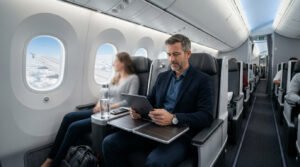
Travel Guidance for People Who Fear Flying: What to Do Mid-Flight
Okay, you’re on the plane. The door is closed. This is where all that prep work either pays off or doesn’t. Here’s what I actually do once I’m in the air.
First, I tell myself one thing: turbulence is not dangerous. It’s uncomfortable, like driving on a bumpy road, but commercial aircraft are engineered to handle forces far beyond anything you’ll ever experience in normal flight. Planes flex. That’s by design. The wings on a Boeing 787 can bend upward by about 26 feet during stress tests. Twenty-six feet. Your little bumps at cruising altitude are nothing.
Second, I stay busy. I pre-download entire seasons of shows on Netflix or load up a long podcast series. Idle brains spiral. Busy brains cope. I also keep a cold water bottle handy because sipping cold water activates your vagus nerve, which helps calm your nervous system. It sounds like a wellness influencer tip, but there’s legitimate science behind it.
If panic starts creeping in, I use the 5-4-3-2-1 grounding technique. Name five things I can see, four I can touch, three I can hear, two I can smell, one I can taste. It pulls your brain out of “what if” mode and anchors it in the present moment. I’ve used this on probably forty flights now, and it has never not worked.
Tell Someone at Work
This part feels vulnerable, but it matters. If you travel frequently for work and your fear of flying is significant, consider telling your manager or HR. You don’t need to give a dramatic speech. A simple “I deal with flight anxiety, and here’s what helps me manage it” goes a long way.
I told my boss after about a year of suffering in silence. Her response surprised me. She adjusted my travel schedule so I had buffer days before big presentations, meaning I didn’t have to fly in the morning and deliver a pitch that afternoon while still shaking off adrenaline. She also approved train travel for trips under four hours, which eliminated several flights per quarter.
Most companies would rather accommodate you than lose a good employee who avoids opportunities because of an unspoken fear. You might be surprised how much flexibility exists if you just ask.

Consider Alternative Travel When Possible
Sometimes the best travel guidance for people who fear flying but must travel for work is to simply fly less. That’s not avoidance. That’s strategy.
Amtrak’s Acela service covers the Northeast corridor faster than flying once you factor in airport time. Washington, D.C. to New York? The train is often quicker door-to-door. I’ve also used Amtrak’s long-distance routes for Midwest trips, booking a roomette so I can sleep and arrive rested instead of wired.
For distances under five or six hours, driving is legitimate. Rent a comfortable car, expense the mileage, and listen to an audiobook. I’ve driven from Chicago to Indianapolis, Nashville, and Detroit for work and arrived in better shape mentally than I ever would have after a flight.
Video conferencing has also permanently changed the calculus. After 2020, most clients accept a Zoom call where they once expected an in-person meeting. Push for virtual when the trip isn’t truly essential. Save your flight-anxiety bandwidth for the trips that genuinely require your physical presence.
Track Your Progress and Celebrate Small Wins
I keep a note in my phone titled “Flights I Survived.” It sounds morbid. It’s actually empowering. Every time I land safely, I add the date, the route, and a one-line note about how I felt. Looking back at that list before a new flight reminds me that I have a 100% survival rate so far. The data speaks for itself.
Your fear might never disappear completely, and that’s fine. Mine hasn’t. But it has shrunk from a monster that consumed entire weeks of my life to a mild annoyance that lasts about twenty minutes during boarding. That shift didn’t happen overnight. It happened because I stacked small tools on top of each other, breathing techniques, seat selection, medication, therapy, routine, and gradually built a system that works.
FAQs
Is fear of flying common among business travelers?
Extremely common. Studies suggest roughly 25% of adults experience some level of flight anxiety, and business travelers often hide it because they worry it looks unprofessional. You’re far from alone, and most frequent flyers you admire have probably dealt with nervousness at some point, even if they never mention it.
Can turbulence actually cause a plane to crash?
No. Modern commercial aircraft handle turbulence with enormous safety margins. Turbulence has not caused a crash of a major commercial airliner in decades. The discomfort is real, but the danger is essentially zero. Pilots adjust altitude and speed to minimize it, and the plane’s structure absorbs the rest effortlessly.
What’s the best travel guidance for people who fear flying on long-haul routes?
Long flights amplify everything, so preparation matters even more. Break the flight into mental segments, like meals, movies, and sleep blocks. Request a seat with extra legroom so you don’t feel confined. Consider discussing a longer-acting anti-anxiety medication with your doctor specifically for flights over six hours.
Should I tell the flight attendants about my anxiety?
Yes, absolutely. Flight attendants deal with nervous passengers constantly and most are genuinely kind about it. They can check on you periodically, explain unusual sounds, and sometimes offer a seat change if one becomes available. I’ve told the crew on at least a dozen flights and never once felt judged.
Do fear-of-flying courses actually work?
They work well for many people. Programs run by airlines like British Airways’ Flying with Confidence course and Virgin Atlantic’s Flying Without Fear have strong track records. They combine education about how planes work with psychological techniques and often end with a supervised flight. The graduation flight alone builds enormous confidence.
Conclusion
Flying scared for work isn’t something you just “get over,” but it is something you can get better at managing, one flight at a time, with the right tools stacked in your favor. I’m proof of that, and so are thousands of other anxious flyers who board planes every week and do their jobs brilliantly on the other side. What’s the one thing you’ve tried that actually helped you fly calmer?